

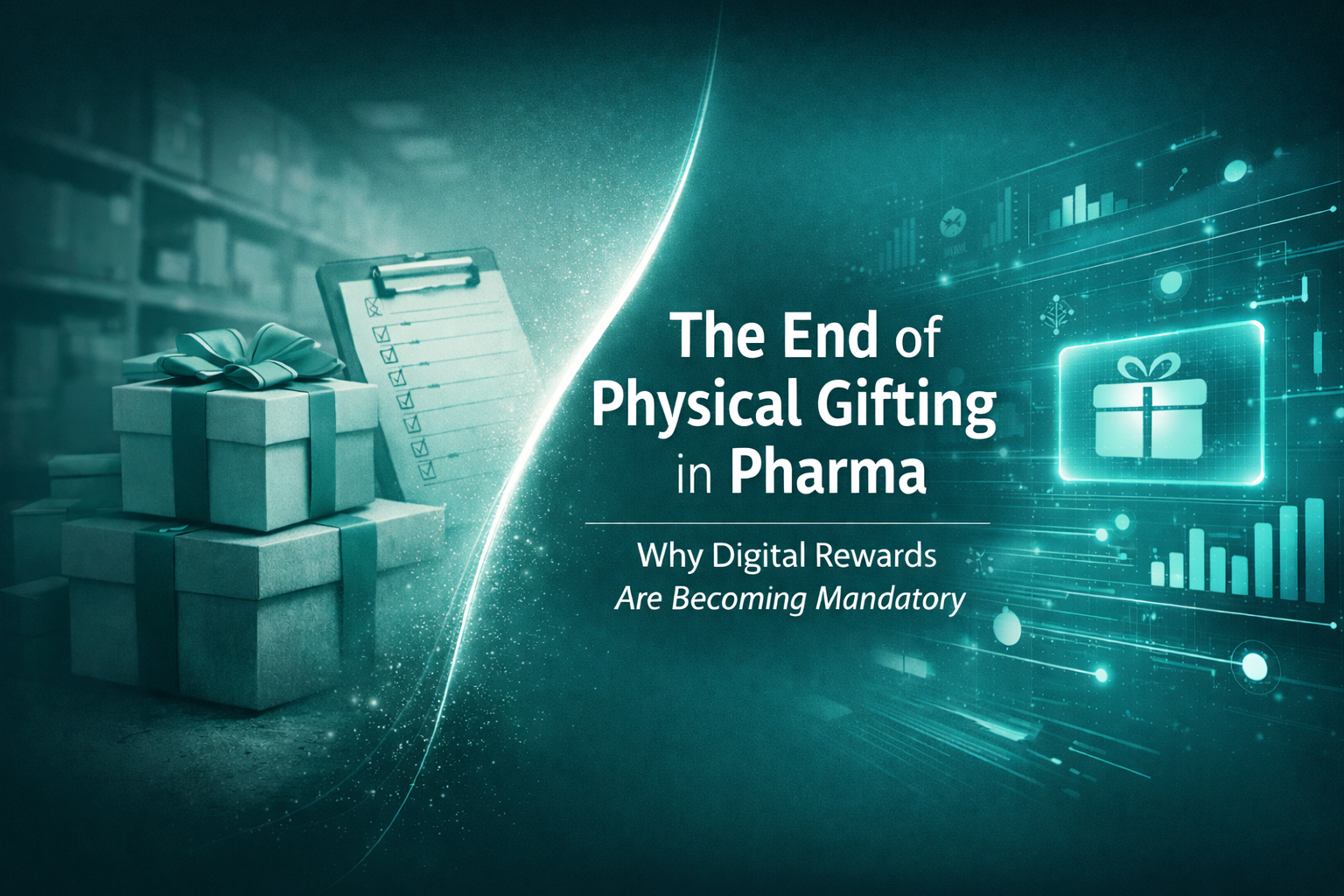
Across emerging and regulated markets alike, pharma marketers are facing a new reality: rising compliance pressure, tightening margins, stronger audit controls, and heightened demand for measurable ROI.
Within this evolving environment, one long-standing engagement practice is being critically re-evaluated — physical gifting.
For decades, pharmaceutical engagement strategies relied heavily on tangible incentives. Branded goods, electronics, sponsored experiences, and event-based rewards were common tools to build relationships with healthcare providers.
Today, that model is under increasing scrutiny. This is not merely an operational shift.
It represents the digital transformation of pharma rewards.
Why the Traditional Model Is Losing Strategic Relevance
Physical gifting was historically built around relationship-building rather than performance analytics.
However, modern pharma marketing operates under three new realities:
- Compliance transparency
- Budget accountability
- Data-driven decision making
These forces are reshaping incentive structures. The end of physical gifting in pharma is not about removing generosity. It is about eliminating opacity.
The Compliance Imperative
Healthcare is among the most regulated industries globally. As markets mature and pharmaceutical companies expand into regulated export territories, internal governance frameworks become stricter.
Traditional gifting methods create operational blind spots:
- Limited tracking after distribution
- Manual reconciliation processes
- Weak audit traceability
- Territory-level visibility gaps
- Fragmented data storage
In contrast, compliant pharma incentive software introduces structured oversight mechanisms. Digital documentation, redemption records, segmentation tracking, and budget transparency become embedded into the system architecture.
For compliance teams, this transition is not optional. It is risk mitigation.
Mandatory digital rewards in healthcare are increasingly becoming the default governance expectation.
The Financial Lens: CFO-Level Scrutiny
Pharma marketers now operate under tighter budget optimization mandates. Senior leadership increasingly asks:
- Which healthcare provider segments respond most effectively?
- What is the incremental prescription lift per incentive tier?
- Which territories outperform relative to engagement spend?
- Is incentive allocation proportionate to revenue growth?
Physical gifting struggles to provide quantitative clarity. Data-driven pharma gifting systems can. Digital rewards introduce measurable engagement metrics:
- Redemption rates
- Behavioral response tracking
- Incentive utilization timelines
- Segment-level ROI analysis
- Campaign effectiveness dashboards
This shift transforms incentives from cost centers into measurable strategic levers.
Operational Efficiency: Removing Friction from Incentive Management
Physical rewards introduce operational complexity:
- Procurement cycles
- Warehousing
- Logistics and distribution
- Inventory management
- Manual approval chains
An automated pharma rewards system streamlines these functions.
Digital delivery reduces logistical burden, lowers administrative overhead, and enables faster campaign execution.
In high-volume pharmaceutical markets, operational agility becomes a competitive advantage.
Behavioral Intelligence: The Strategic Edge
One of the most under-discussed advantages of pharma virtual gifting solutions is behavioral data capture.
Digital reward ecosystems allow marketers to analyze:
- Engagement frequency
- Incentive responsiveness by tier
- Product-category affinity
- Regional adoption patterns
- Campaign fatigue indicators
This level of insight enables more precise segmentation.
Trackable healthcare provider incentives allow pharma brands to design performance-based engagement models rather than blanket distribution strategies.
Modernizing pharmaceutical incentives means aligning them with measurable behavioral outcomes.
The Role of AI in Incentive Evolution
AI driven gifting solutions represent the next frontier in pharmaceutical engagement.
Predictive analytics can:
- Recommend optimal incentive tiers
- Identify underperforming segments
- Forecast engagement impact
- Optimize budget allocation
- Detect compliance anomalies
Artificial intelligence transforms digital reward platforms from transactional tools into strategic intelligence engines.
This evolution is redefining what a pharmaceutical digital rewards platform can accomplish.
Global Trends Supporting the Shift
Several macro-level developments reinforce the movement toward digital incentives:
- Increasing anti-bribery and anti-corruption enforcement
- Rising healthcare transparency regulations
- Growing demand for audit-ready systems
- Globalization of pharmaceutical exports
- Post-pandemic digital acceleration
Replacing physical gifts with digital rewards is increasingly aligned with industry modernization.
The transformation is not reactive. It is structural.
What Pharma Marketers Should Evaluate Today
For commercial and brand leaders, the transition toward digital engagement requires strategic planning.
Key evaluation criteria include:
- Compliance alignment
- Audit readiness
- Segmentation capabilities
- Data analytics infrastructure
- Automation depth
- AI integration potential
- Governance controls
Digital transformation of pharma rewards is not about adopting technology for novelty.
It is about embedding governance, intelligence, and efficiency into engagement systems.
The Emerging Standard
As the industry evolves, the expectation is shifting from:
“Incentives distributed.”
To:
“Incentives measured.”
The future of pharmaceutical engagement will be defined by:
- Trackability
- Measurability
- Segmentation intelligence
- Compliance robustness
- Automation
- Data integration
Organizations that modernize early gain structural advantages.
Those that delay may face governance and performance gaps.
A Strategic Inflection Point
Pharmaceutical engagement is entering a measurable era.
Mandatory digital rewards in healthcare are not a marketing trend.
They are the natural outcome of compliance evolution, financial accountability, and technological advancement.
The conversation is no longer whether digital systems will replace physical models.
The real question is:
How quickly will organizations adapt?
Conclusion
The end of physical gifting in pharma represents more than operational change.
It reflects a deeper industry transformation — one where incentives are governed, data-driven, compliant, and strategically optimized.
As pharma marketers navigate increasingly complex regulatory and financial landscapes, incentive modernization will become a defining factor of commercial performance.
The transition has already begun. The next step is strategic implementation.
Share:


Let’s Connect to Bring Your Gifting Ideas to Life!
Contact our team to implement your gifting idea. If you have any questions regarding gifting or reward strategy, let's work together to find an impactful solution. We look forward to hearing from you!


